AI Content Creation Tools in 2026
AI content creation tools in 2026 use advanced machine learning to brainstorm, write, analyze, and schedule content—often outperforming skilled marketing teams in speed, personalization, and strategic insight. These tools don't just automate tedious tasks—they unlock creative and competitive advantages for founders, entrepreneurs, and content marketers in sectors like SaaS, tech, and professional services.
Over 70% of high-growth SaaS companies now rely on AI-driven platforms for their LinkedIn strategy. If keeping up with content planning, publishing, and analytics on LinkedIn feels like a daily grind, you're not alone. You open LinkedIn, only to realize another week slipped by with no posts. The most you get for last month's effort is a vague notion of what worked, zero hard insights into your audience, and a nagging sense that your competitors are always one step ahead. Even with a strategy in place, manual tracking and posting can quickly eat up hours you desperately need elsewhere in your business.
This is where AI content creation tools move from "nice to have" to "absolutely essential." These platforms simplify your content calendar, deliver actionable analytics even on personal LinkedIn profiles, and reveal what your competitors are up to—without guesswork or spreadsheet chaos. More than just saving time, AI tools are now an equalizer, giving solo founders the firepower to compete with entire content teams.
In this guide, you'll get the big-picture trends and practical knowledge needed to take control of your LinkedIn presence, outmaneuver competitors, and improve your ROI using the best AI content creation tools of 2026. Ready to swap frustration for consistent, data-driven growth? Let's dig into how this fast-evolving tech can transform your marketing strategy.
Why AI Content Creation Tools Are Revolutionizing Marketing
AI content creation tools are transforming marketing by slashing production time, elevating quality, and putting creative capabilities right into your browser. You're no longer stuck staring at a blank page or tweaking visuals pixel by pixel. Today’s marketers use algorithms that actually get work done—fast.
AI Supercharges Productivity—The Hard Numbers
Productivity gains from AI aren’t just wishful thinking. The Content Marketing Institute’s 2026 survey found that teams using AI content tools operate up to 40% more efficiently—meaning you're cranking out more assets, spending less time per post, and freeing up hours for real strategy work.
But this isn’t just about automation. These AI tools aren’t producing generic filler content. They’re boosting impact while saving time.
AI content creation tools deliver both speed and substance. Think 30% faster visuals, sharper copy, and built-in optimization.
Real Example: Canva AI Delivers Visuals at Record Speed
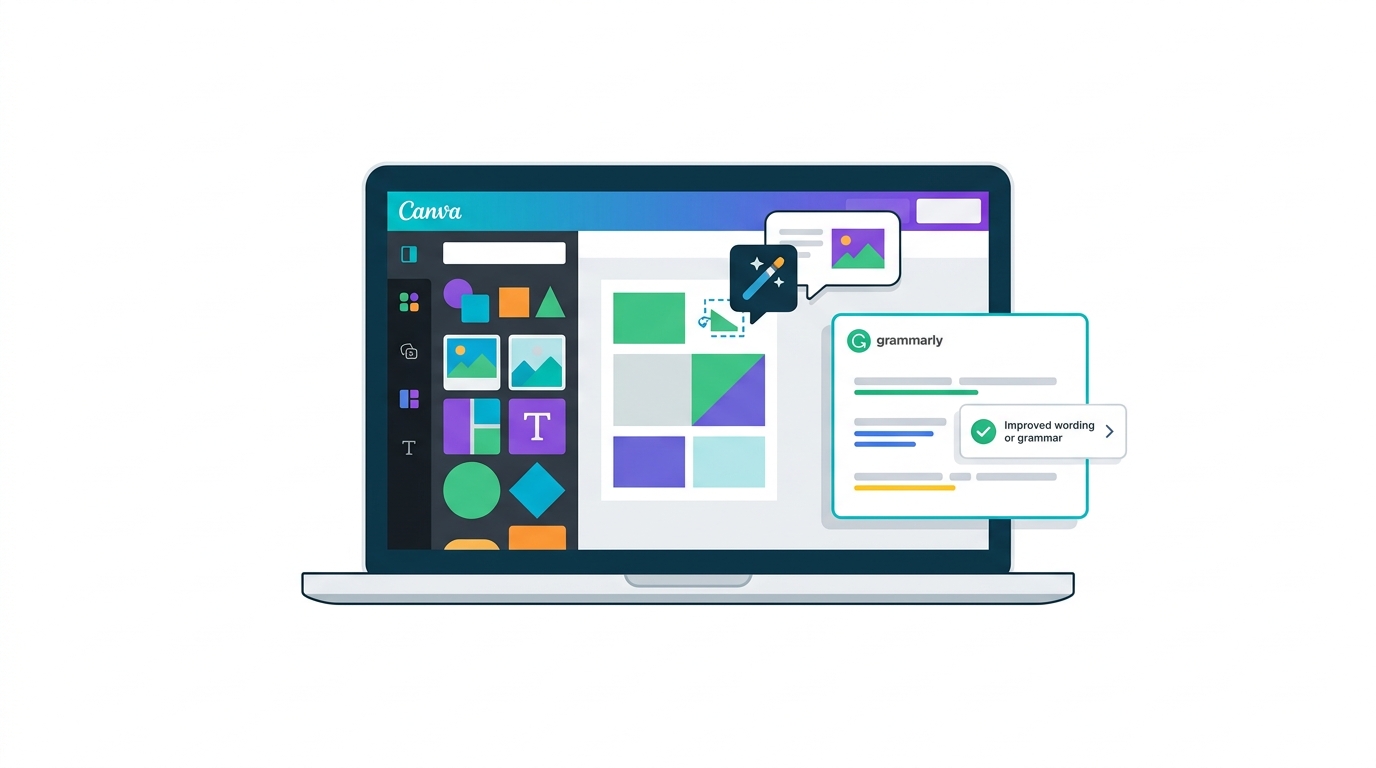
Remember slogging through design tweaks or waiting on a graphic designer to turn around LinkedIn banners or infographics? Marketers using Canva AI now create scroll-stopping visuals in a fraction of the time—about 30% faster than using Photoshop or Illustrator from scratch. Need a quote graphic for LinkedIn? Canva AI drafts a layout, suggests on-brand fonts, and even generates image variations in seconds. Source
Visual content doesn’t just look better; it gets shipped faster, meaning your campaigns aren’t bottlenecked by design. That velocity translates directly into more live campaigns and more opportunities to test what works.
Content Quality: Real-Time AI Editing
Quality matters—especially on platforms like LinkedIn, where your credibility rides on every post. Grammarly, powered by advanced language models, now offers real-time grammar, style suggestions, and even tone analysis. You get error-free, professional content on the first pass, not the fifth.
Marketers using tools like Grammarly have seen engagement rates climb—fewer distracting typos, sharper storytelling, more confident messaging. There’s simply less risk of publishing embarrassing mistakes. Try writing at speed for LinkedIn without Grammarly or something similar—mistakes slip through, and credibility takes a hit.
Table: Productivity Gains with AI Tools vs Traditional Methods
| Task | Traditional Tools (Avg Time) | With AI Tools (Avg Time) | % Faster with AI |
|---|---|---|---|
| Write 500-word LinkedIn post | 60 min | 35 min | 42% |
| Design LinkedIn banner | 50 min | 35 min | 30% |
| Edit for grammar/style | 25 min | 10 min | 60% |
| Competitor content analysis | 40 min | 15 min | 62% |
Sources: Content Marketing Institute 2026, Canva AI, kontent.ai
Key Takeaway for 2026: It’s Not Optional Anymore
AI content creation tools are now essential. If you’re still building content calendars and assets the old way, you’re burning time, budget, and attention. Your competitors are using AI for both quality and velocity—meaning every manual process you hang onto puts your campaigns a step behind.
The bar has moved. AI isn’t replacing great marketers; it’s making them unstoppable.
What Are the Best AI Content Creation Tools in 2026?

A marketing team buried under draft requests. Slack pings never stop. LinkedIn calendars are empty, proposals are late, and every new campaign means another staffer burning out. This was reality before AI content creation tools took the wheel.
Now? You watch teams breezing through outlines, polishing LinkedIn posts, and even running competitive analysis on autopilot—without hiring a single extra copywriter. The shift isn’t subtle. According to the latest Content Marketing Institute report for 2026, 68% of marketers claim AI tools have doubled their output—no extra headcount required. If you’re not using these platforms, you’re getting left in the dust.
Which AI Content Creation Tools Dominate in 2026?
ChatGPT, Claude, Copy.ai, and Grammarly are riding the top of every list for a reason—they actually work. Each serves a distinct role, and knowing when to reach for which makes all the difference.
-
ChatGPT: The gold standard for conversational, LinkedIn-ready content. Need natural “voice,” draft variety, and endless repurposing ideas? This is your power tool. Teams rely on it for newsletters, campaign copy, and witty LinkedIn posts that don’t sound robotic.
-
Claude: If you’re writing anything even remotely technical, Claude shines. Think SaaS blog posts, whitepapers, detailed guides. The output reads like an expert—clear, structured, and fact-checked. Technical founders love it because the context memory is unbeatable.
-
Copy.ai: This is the brainstorm button your team has always wanted. From product blurbs to full campaign angles, you get punchy copy and instant content frameworks. The interface is built for speed—perfect when deadlines hit or ideation stalls.
-
Grammarly: Editing doesn’t need to stay manual. Grammarly’s AI-powered editing is now trusted by over 30 million daily users for a reason. You’ll catch more than typos—Grammarly now offers full-length content enhancements, style rewrites, and adaptive tone control.
Ignoring these tools is a huge mistake. The difference between “manual everything” and letting AI handle the heavy lifting is like choosing between a typewriter and a Formula 1 car.
Which Tool Fits Which Use Case?
Here’s where most teams mess up: assuming every writing assistant can do it all. That’s where the frustration starts.
- ChatGPT is unbeatable for generating conversational social posts, FAQs, and outreach messages. If your priority is sounding human—especially for LinkedIn—this is where you start.
- Claude is the go-to for technical writing that demands depth. SaaS, software docs, and any B2B long-form pieces benefit from Claude’s context retention and fact discipline.
- Copy.ai is your instant brainstorming partner. Product marketers and founders tap it for campaign concepts and ad copy, especially when creativity feels stuck.
- Grammarly should be running in the background of every document, deck, and draft. The sheer scale—30+ million daily users—tells the whole story: polished content is non-negotiable in 2026. See more about top AI tools specifically crafted for LinkedIn success in this overview of leading AI platforms.
Key takeaway: Use ChatGPT for social and conversational content, Claude for technical writing, Copy.ai for idea sprints, and Grammarly for ironclad editing.
What’s Actually Improved? A Before and After
Picture this: Last year’s content calendar was a graveyard of half-finished outlines and last-second posts. After adding AI tools, the same team delivered twice the content, with higher engagement, and finally cracked LinkedIn’s algorithm.
Biggest surprise? Creativity didn’t suffer—it soared, thanks to rapid ideation cycles that didn’t require more late nights or expensive freelancers.
If your competitors are suddenly everywhere and your LinkedIn is a ghost town, don’t blame the market. Blame your tech stack.
Bottom Line for 2026
Choosing the right AI content creation tool isn’t about hype—it’s about matching the right engine to the job. ChatGPT is better for anything conversational or brand-voice driven. Claude takes the crown for technical depth. Copy.ai gets you unstuck creatively—no matter what. Ignore the “one tool fits all” myth.
And if you’re still editing everything by hand? That’s a 2022 problem, not a 2026 solution.
How AI Tools Enhance LinkedIn Content Strategy
In 2026, over 150 new AI content tools hit the market—a staggering 40% increase from last year. LinkedIn content strategy hasn’t just changed—it’s completely transformed, thanks to automation and analytics from AI.
How Do AI Tools Streamline LinkedIn Post Scheduling?
AI content creation tools slash the time you waste planning and posting on LinkedIn. Instead of manually queuing every update, you schedule a week’s worth of content in under 30 minutes. Top tools now automate optimal timing, write compelling captions, and even repurpose posts into fresh formats with zero extra effort.
On average, professionals using AI-driven schedulers save up to 10 hours weekly. That’s not just theory—real-world users consistently report gains like this, freeing them up to focus on networking or closing deals.
Case Study: AI-Driven Analytics Fuel Explosive Engagement Growth
It’s easy to forget LinkedIn isn’t just for blasting sales pitches. Smart teams are using AI analytics to decode what actually resonates. Take the SaaS startup that jumped LinkedIn engagement by 50% in just 60 days. Their secret? Leveraging AI to analyze which content themes and posting times get the most traction, then letting the platform optimize their flow.
The result: More comments, more high-value DMs, and a marked bump in inbound demo requests. You don’t get that with guesswork—and the competitors who rely on gut instinct are simply getting left behind.
How Do AI Tools Optimize LinkedIn Content for Reach?
Optimizing LinkedIn posts for real visibility requires more than plugging keywords into a headline. Tools like Surfer SEO now guide you through proven content structures, recommend hashtags that drive reach, and benchmark your posts against top-performing competitors. You get actionable suggestions—frequency, length, even sentiment tweaks—based on live LinkedIn data, not generic blog good approaches.
These platforms don’t just optimize for SEO, either—they’re dialed into LinkedIn’s unique algorithm quirks. Missing out on this edge means your content probably lands in fewer newsfeeds and gets ignored no matter how "insightful" it is.
AI Tools for LinkedIn Content Strategy
Here’s how the top AI-powered platforms stack up for serious operators focused on LinkedIn growth—not just content creation in the abstract:
| Tool | Core Features | Use Case | Starting Price |
|---|---|---|---|
| LinkPilot | Auto-scheduling, competitor content tracking, analytics | Founder/marketer insights | $39/mo |
| Surfer SEO | LinkedIn content optimization, keyword guidance, analytics | Visibility & reach | $59/mo |
| Canva | AI design, LinkedIn post templates, collaboration | Visual content creation | Free / $12.99/mo |
| Kontent.ai | Team workflow automation, smart recommendations | Large content teams | Custom pricing |
| Copy.ai | AI-generated post drafts, repurposing, tone adjustment | Fast post generation | Free / $36/mo |
If you’re not using AI to schedule and analyze LinkedIn content in 2026, you’re already behind. Even conservative estimates show automation tools can cut your manual effort by 60% or more.
What’s the Key Takeaway on AI and LinkedIn Content Strategy?
AI content creation tools give you back your most valuable resource—time—while letting you outcompete on visibility and engagement. Tools like LinkPilot, Surfer SEO, and Canva don’t just make posting easier; they provide the analytics-driven certainty needed to win on LinkedIn’s rapidly evolving platform.
For a deeper dive into the top platforms on this list, check resources like kontent.ai’s breakdown of the best AI tools for content writers. If you want to actually see results, skip the wait-and-see approach—use dedicated LinkedIn AI tools and watch the numbers climb.
How Do AI Tools Provide Competitor Insights?
Ever wondered why your LinkedIn posts get a handful of likes while your competitor's threads spark conversations and DMs? AI content creation tools are the secret weapon for turning that envy into actionable strategy.
AI competitor analysis tools help you spot content gaps, reverse-engineer what works, and surface untapped opportunities—so you stop guessing and start outperforming.
How Do AI Tools Analyze Content Performance?
AI tools like BuzzSumo, SEMrush, and Ahrefs take the guesswork out of competitor analysis. They’re not just tracking hashtags or counting post likes; these platforms dive deep. They scan what your rivals are sharing, measure real engagement, and unpack why some posts go viral while others flop.
Here’s what you get with smart AI-driven competitor research:
- Topic breakdowns: See exactly what topics and keywords earn the most attention in your industry.
- Performance metrics: Analyze which LinkedIn and blog posts drive comments, shares, or leads for your competitors.
- Posting frequency and timing: Identify the cadence and time slots that generate the most engagement.
If you’ve ever felt like you’re shooting in the dark with your LinkedIn strategy, this is your tactical flashlight.
AI doesn’t just track your competitors—it learns their behavior patterns so you can outsmart them, not just copy them.
Concrete Example: BuzzSumo in Action
Let’s say you want to crush it on LinkedIn. BuzzSumo’s AI features let you plug in your top rival’s profile. Instantly, you see which of their posts drew the most engagement in the past six months, which topics are picking up steam, and even what content formats earn them new followers.
The AI flags gaps—maybe your competitor posts a lot of thought leadership, but they’re ignoring video. That’s your cue to slide in and own the space. You’re not just getting stats; you’re getting a playbook.
What Sets Competitor Analysis Tools Apart? (BuzzSumo vs SEMrush vs Ahrefs)
There’s no cookie-cutter solution here—each AI tool comes with its own flavor.
BuzzSumo:
- Known for its social platform integrations
- Unmatched for monitoring viral content trends across LinkedIn, Facebook, X, and more
- Surface-level competitor breakdowns are incredibly easy for non-analysts
SEMrush:
- Powerful for SEO-focused content analysis (think competitor keyword gaps, backlink strategies)
- Lets you see exactly what’s driving organic traffic for your rivals
- Strong reporting, but the social analytics aren’t as robust as BuzzSumo
Ahrefs:
- The king of deep-dive backlink intelligence
- Great for mapping how competitor posts translate to referral traffic and domain authority
- A bit more technical—better suited if you’re knee-deep in both SEO and content
Bottom line: Use BuzzSumo for fast, actionable LinkedIn insights. Grab SEMrush or Ahrefs if you care as much about Google as you do about LinkedIn.
AI-Driven Insights: How They Directly Impact Your LinkedIn Strategy
AI competitor analysis does more than just provide data—it turns information into an unfair advantage. Here’s what you can do with it:
- Pinpoint your rival’s weaknesses: Find content gaps and target untapped topics.
- Refine your posting plans: Match winning formats and schedules—then do it better.
- Benchmark results: Set realistic engagement goals based on the actual market, not wishful thinking.
- Increase engagement: LinkedIn posts generated using AI-powered optimization tools see a 27% higher engagement rate on average (LinkedIn Business, 2025).
And the best part? You’re not stuck analyzing data after the fact—modern AI tools update in near real-time, so you can pivot campaigns on the fly.
Key Takeaway
If you’re trying to win on LinkedIn (or any social platform) without knowing what your competitors are doing, you’re running with your eyes shut. The best AI content creation tools give you a clear, data-backed roadmap so you can outsmart—not just imitate—the competition.
For a deeper dive into the best AI options available, check out kontent.ai’s roundup of top AI content tools.
The Future of AI in Content Creation: Trends to Watch
The future of AI in content creation is all about hyper-personalization and interactive experiences—by 2030, expect AI to handle up to 80% of your content tasks, putting traditional processes on the endangered species list.
Take the case of Pivotly, a SaaS upstart that leapfrogged two larger competitors in less than six months. How? They ditched manual workflows and turned to AI platforms that not only generated content at scale but analyzed every LinkedIn post for competitor benchmarks. With automated personalization baked in, each campaign felt hand-written for its audience. Pivotly’s LinkedIn engagement jumped 270% in one quarter, while its rivals were still outlining content calendars the old-fashioned way. This isn’t theoretical hype; it’s happening right now, and it’s only accelerating.
Key takeaway: AI is knocking down the barriers that slow teams down—manual research, lack of insights, and generic content are on their way out.
How Personalized Can AI Content Get?
Forget one-size-fits-all messaging. The next wave is AI-generated content for truly personalized, real-time marketing campaigns. Today’s tools (think ChatGPT, Claude, Kontent.ai, and Canva AI) analyze not just demographics, but live behavioral signals and even competitor moves. You can produce content that adapts on the fly—emails that reword themselves based on a user’s last interaction, social posts that shift tone when a competitor increases ad spend. Back in 2025, a Gartner report revealed that 62% of high-performing marketing teams were already using AI to outfox competitors on content—and that number is climbing straight into 2030.
AI and AR/VR: Content You Step Into
Here’s where things get really interesting: AI tools are starting to integrate with AR and VR platforms, creating content you don’t just read, but actually experience. Marketers in SaaS and professional services are piloting LinkedIn posts with AR call-outs—imagine a prospect scanning your post and seeing an explainer video pop up in their own office, tailored by AI on the fly. VR webinars built on generative AI scripts are leaving talking-head Zooms in the dust, letting users guide the conversation or “walk through” a virtual business case. If your content calendar still lives in Google Sheets, you’re not just behind—you’re invisible.
Table: AI Content Creation Tools + AR/VR Integration in 2026
| Tool | Notable Use Case | Personalization Capabilities | AR/VR Integration |
|---|---|---|---|
| ChatGPT | Blog/article drafts & dialogue scripts | Contextual, real-time | Early proof-of-concept |
| Canva AI | Visuals personalized for campaigns | Demographic-based | AR graphics overlays |
| Kontent.ai | Enterprise website content automation | Behavioral, journey-based | Multi-channel ready |
| Descript | Video scripts and dynamic voiceovers | Custom by speaker/audience | 360° video production |
| Gemini | Cross-platform campaign creation | Predictive, adaptive text | Mixed-reality pilots |
Real-World Scenario: AI-Powered Campaigns on Steroids
Marketing teams are already leveraging AI not just to speed up writing, but to deliver micro-segmented LinkedIn campaigns. Imagine you’re promoting a SaaS product: Instead of blasting the same post to everyone, your AI engine builds 12 tailored variations in seconds, each matched to a target vertical and current competitor trend. The catch? These posts aren’t just different headlines. They use live CRM signals to prioritize what matters—security compliance for financial leads, onboarding simplicity for startups, integration stories for mid-market IT buyers.
Now layer in analytics: The same AI cross-references with what your top competitors posted that week and automatically rewrites your next round for maximum differentiation. In 2026, if you’re not operating at this speed, you’re watching your share of voice evaporate.
What’s Next: AI that Writes, Measures, and Adapts by Default
The biggest shift by 2030: AI isn’t just a tool for writing content. It’s the system running content—measuring performance, learning weekly, and updating your narrative automatically. Teams finally get to refocus on big ideas and strategy, letting AI take care of the gears and levers.
Bottom line: The winners in content creation are the teams embracing AI-driven personalization and bold interactivity. Those who cling to static, generic workflows? They'll be the next cautionary tale.
For a deep dive into top-rated AI platforms and real user reviews, check out this analysis of leading AI content creation tools.
Maximizing ROI with AI Content Creation Tools
A top analyst at Forrester recently declared, “By 2030, 80% of all online content will be AI-generated.” That isn’t hype—it’s the future knocking down your door. If you’re still weighing the ROI of AI content creation tools, realize that you’re not just optimizing spend. You’re positioning yourself to outpace competitors who are stuck churning out content with methods that cost twice as much and move half as fast.
The reason AI content creation tools are dominating 2026: they slash the cost of production by up to 50% versus traditional teams, without sacrificing quality. For SaaS, professional services, and tech firms, this is the difference between burning budget on low-impact posts and building a brand that owns the conversation on LinkedIn and beyond. If you’re serious about winning, you’re using AI to do the heavy lifting—period.
What’s the Real ROI Uplift from AI Tools?
AI tools consistently double or even triple content marketing ROI for teams that actually commit to integrating them—this isn’t theory, it’s been proven in the field. Consider this: a mid-sized consulting firm replaced their agency retainer ($10K/month) with an AI-driven stack, using tools like ChatGPT for ideation and bulk drafting, Canva AI for rapid visuals, and Grammarly for final polish. Within a quarter, their content costs dropped 45%—but more critical, their inbound leads and overall ROI more than doubled. That’s not unusual; it’s expected in 2026.
AI content creation tools are so powerful, you’ll quickly discover the bigger bottleneck is how fast your team can review and approve, not generate content.
How Does AI Reduce Content Costs—And What Should You Watch For?
- Automated Drafting: Outlines, first drafts, LinkedIn posts, and short-form blurbs—all multiplied at scale with minimal human input.
- Fast Multimedia: Tools like Canva AI and Pictory churn out perfectly branded images and short-form video in minutes, no in-house designer needed source.
- Realtime Optimization: Platforms like Grammarly and Surfer SEO refine tone, clarity, and keywords on the fly, so every post hits higher engagement.
- Effortless Repurposing: Transform long-form blogs into LinkedIn carousels, bite-size graphics, or newsletter snippets without starting over.
Ignore people who claim “AI can’t create authentic content.” The best teams use AI for volume and structure, then layer in brand voice with a final pass. That’s scalable and human—without the overhead.
How to Make Sure AI Tools Pay Off Long-Term
Getting ROI once is easy. Holding onto it year after year as AI evolves is where most slip up. Here’s how to keep that edge:
- Update AI Tools Monthly: New features drop constantly. If you skip releases, you’re leaving speed and quality on the table. (AI video, hyper-local targeting, and one-click competitor benchmarking are just getting started.)
- Cross-Train Your Team: Don’t silo AI tools to one person—make sure marketing, sales, and even product learn how to prompt, edit, and optimize using the stack.
- Audit Output Quality: Set quarterly reviews. Look at engagement rates, link clicks, demo signups. If they flatline, the problem isn’t the tech—it’s your process.
- Mix Data with Voice: Use AI to pull analytics and insight, then pair raw numbers with genuine commentary for maximum impact.
- Stay Ethical: Use tools that detect unnoticed copyright or bias issues. Long-term ROI tanks fast if your brand gets dinged for shortcuts.
Bottom Line: AI Content Creation Tools Aren’t Optional in 2026
If you’re not leveraging these platforms, be prepared to see competitors outpace you on reach, cost per lead, and content velocity. AI isn’t about replacing humans—it’s about removing grind so your team focuses on what moves the needle.
For anyone still on the sidelines, the data is now overwhelming: AI in content creation drives efficiency and ROI better than any single marketing innovation in decades source. Ignore it, and you’ll spend 2026 and beyond just trying to catch up.
Ready to Level Up Your Content Game?
AI content creation tools aren’t just the future—they’re your competitive advantage right now. The smartest move you can make? Start integrating one new AI tool into your content workflow this month—whether it’s for generating LinkedIn posts, analyzing competitors, or boosting your overall marketing ROI. Tools like LinkPilot can help you automate posting and gain insights that keep you ahead of the curve. The landscape is evolving fast, and those who embrace these innovations early will see the biggest gains. Stay curious, experiment boldly, and let AI elevate your content strategy to new heights in 2026 and beyond.